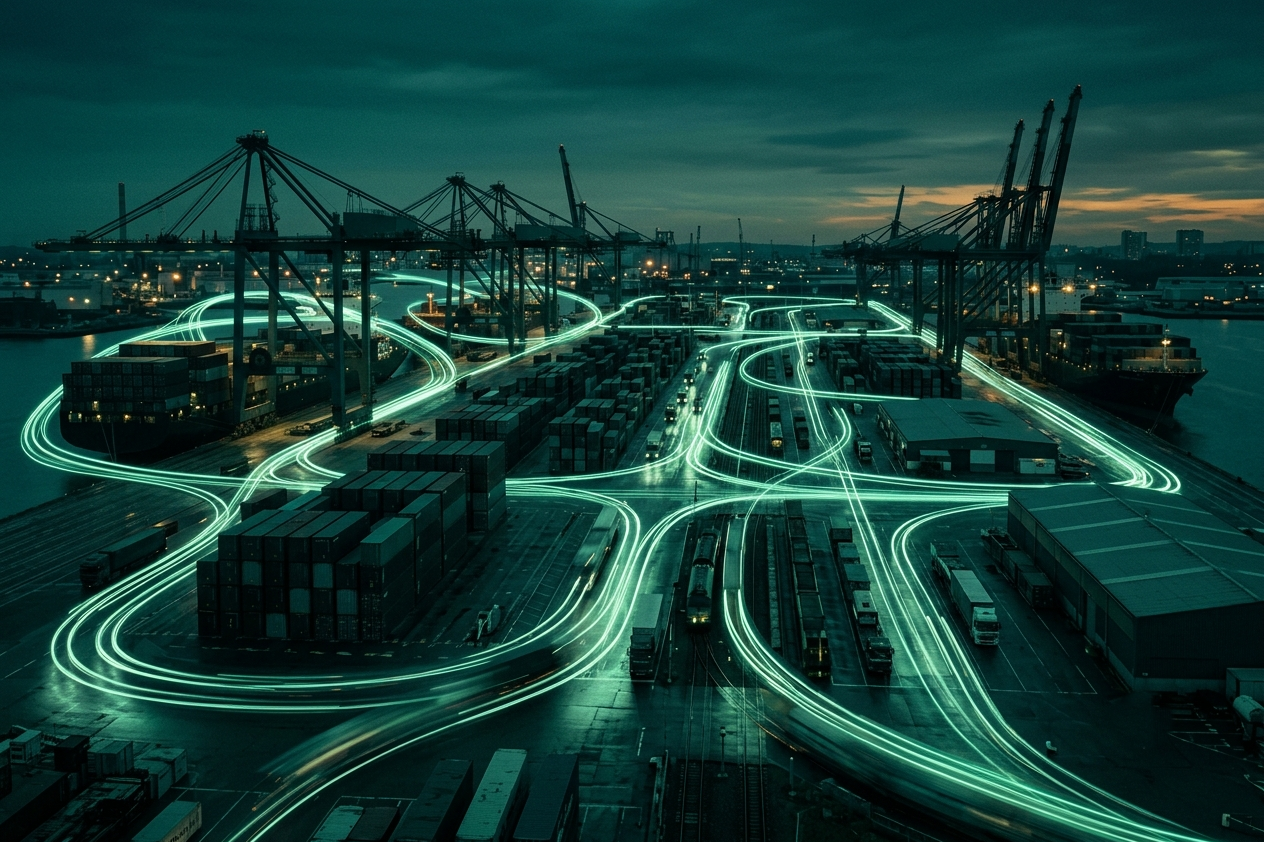
A new architecture of global trade is being drawn between three regions that together hold most of the world’s population growth, energy transition capital, and unmet infrastructure demand: India, the Gulf, and Europe. The India-Middle East-Europe Economic Corridor, announced at the 2023 G20 summit in New Delhi and still under active diplomatic construction in 2026, is the most visible expression of this shift. It proposes an integrated network of rail, shipping, energy, and digital infrastructure linking Mumbai to Marseille through the Arabian Peninsula and the Eastern Mediterranean, in a route that promoters argue could move goods significantly faster than the existing Suez-dependent path.
Alongside this infrastructure logic runs a second, less discussed one: capital logic. Gulf sovereign wealth funds now manage several trillion dollars in combined assets, and their allocators have spent the last decade shifting from passive financial positions toward direct operating stakes in ports, energy grids, advanced manufacturing, logistics platforms, and technology infrastructure across Europe. This is not simply money looking for yield. It is diversification strategy for post-oil economies, and it is increasingly deliberate about where it lands.
The question this raises for European regions is rarely asked in national-level policy discussions, but it is the one that matters operationally: when Gulf capital and Gulf-linked trade infrastructure look for a European landing point, which regions are actually positioned to receive them — and which are simply hoping to be noticed?
The architecture of the corridor
IMEC is structured around three integrated pillars: a transport backbone combining rail and maritime links between the Gulf and Europe; an energy pillar connecting electricity grids and hydrogen infrastructure across the route; and a digital pillar built on new fiber-optic and cross-border data infrastructure. The corridor is generally described as two connected segments, an eastern route linking India to the Gulf, and a northern route carrying that flow onward from the Gulf into Europe through the Levant and the Mediterranean.
As of 2026, the project remains in a feasibility and coordination phase. No corridor-specific construction has begun as a unified initiative, though individual national components, Gulf rail expansion, port modernization in the UAE and Saudi Arabia, continue to advance independently of the diplomatic process. The corridor’s completion depends on politically difficult conditions, most notably a level of operational cooperation between Israel and Saudi Arabia that regional instability has repeatedly complicated. Italy has positioned itself assertively within this process, promoting the port of Trieste as the corridor’s natural European gateway and hosting recurring IMEC coordination forums through 2026.
This is precisely the kind of positioning contest regions should be watching. Trieste’s bid is not an accident of geography; it is the result of a deliberate, sustained institutional campaign to be recognized as the corridor’s European terminus. Other regions, including Atlantic-facing territories with port and logistics capacity, have made no equivalent claim, and by default cannot expect equivalent attention.
The capital behind the corridor
Infrastructure diplomacy is only half the story. The more immediately actionable half, for regional economic development actors, is the capital sitting behind it. Five Gulf sovereign wealth funds, Saudi Arabia’s Public Investment Fund, the Qatar Investment Authority, and the UAE’s Abu Dhabi Investment Authority, Mubadala, and ADQ, have ranked among the world’s most active sovereign investors for three consecutive years, collectively managing an amount now estimated in the range of four to five trillion dollars, with credible projections putting that figure closer to seven trillion by the end of the decade.
The character of this capital has changed. A decade ago, Gulf funds behaved largely as passive financial investors. Today they routinely anchor or lead direct transactions in infrastructure, energy, advanced manufacturing, and technology platforms, and they increasingly favour operating stakes over portfolio exposure. Mubadala alone reported assets under management approaching 385 billion dollars by the end of 2025, with continued active expansion into Western markets even as some funds maintain more cautious postures in politically sensitive geographies.
For European regions, the practical implication is this: Gulf capital is no longer simply looking for London, Paris, or Frankfurt. It is looking for operating assets, ports, energy platforms, logistics land, advanced manufacturing capacity, that align with the diversification mandates of Vision 2030-era economic strategies. A region that can demonstrate available, de-risked, well-governed assets in these categories is a plausible counterparty. A region that cannot articulate what it has to offer, in terms legible to an international investment committee, is simply invisible to this capital, regardless of its underlying potential.
Why the corridor does not end at the port
A common misreading of corridor diplomacy is to treat it as a story about hubs alone, Trieste, Piraeus, a handful of flagship Mediterranean ports, and to assume that everything behind the gateway is secondary. This misses how trade and investment corridors actually distribute value. A corridor’s economic effect is not confined to the point of entry; it extends into the hinterland regions that can absorb, process, store, manufacture with, or add value to what moves through the gateway. Ports without adjacent industrial and logistics capacity capture transit fees. Regions with the right combination of land, energy, connectivity, and skilled labour capture production, assembly, and distribution activity, which is where the durable economic value actually sits.
This is precisely where second-tier and Atlantic-facing regions have a genuine, underexploited argument to make. They will rarely win the symbolic fight to be named a corridor terminus. They can credibly compete to be the place where corridor-linked capital and corridor-linked trade actually get put to work, in green hydrogen production, in component manufacturing, in agrifood processing tied to Gulf food-security strategy, in data infrastructure supporting the corridor’s digital pillar. That argument, however, has to be made explicitly and with evidence. It does not make itself.
Where Gulf strategy and European regional strategy actually converge
Four sectors stand out as genuine points of convergence between Gulf capital priorities and the kind of industrial and territorial assets that mid-sized European regions can realistically offer.
Energy is the clearest. Gulf funds are deploying capital into green hydrogen, renewable generation, and interconnected electricity infrastructure as part of both the corridor’s energy pillar and their own domestic diversification mandates. Regions with renewable generation capacity, port access, and available industrial land are natural counterparties for this kind of investment, not as recipients of aid, but as commercial partners in Gulf energy diversification.
Food security is the second, and it is less obvious but arguably more durable. Gulf states import the large majority of their food and have made agricultural investment abroad a explicit strategic priority for decades. European regions with strong agrifood production, processing capacity, and export infrastructure have a direct, commercially legible offer to make here.
Advanced manufacturing and logistics form the third convergence point, tied to the corridor’s transport pillar: component production, assembly, and distribution capacity positioned to serve both European and, via the corridor, Gulf and South Asian markets.
Digital and data infrastructure is the fourth, linked to the corridor’s fiber and connectivity pillar, and increasingly attractive to funds diversifying into technology platforms rather than pure real assets.
None of these four categories requires a region to be a national capital or a mega-port. They require the region to be legible, credible, and specific about what it actually has.
What "investment-ready" actually means to an allocator
Gulf sovereign funds, unlike much development-oriented European funding, are not evaluating opportunities against social or cohesion criteria. They are evaluating them the way any large institutional allocator does: governance quality, regulatory predictability, the credibility of the counterparty, and the clarity of the underlying asset or pipeline. A region can have excellent renewable resources, strong agrifood production, or genuine logistics capacity, and still be functionally invisible to this capital if that offer is not packaged, translated, and presented in the language an investment committee actually uses.
This is a governance and communication gap far more than a resource gap, and it is precisely the gap that most peripheral or intermediate European regions fail to close. They compete on the basis of subsidy and cost, categories where they will structurally lose to larger or cheaper jurisdictions, instead of competing on the basis of specificity, reliability, and legibility, categories where a well-organized smaller region can credibly outperform a larger but less coherent one.
The risks worth naming
None of this is without complication, and a credible analysis has to hold both sides. IMEC’s diplomatic foundation remains fragile: it depends on a level of Israeli-Saudi cooperation that regional conflict has repeatedly set back, and it lacks, as of 2026, a single coordinating body with the authority to move it from memorandum to construction. Gulf sovereign capital, while increasingly assertive, is also selective and cautious about geopolitical exposure, and it gravitates toward jurisdictions that can demonstrate institutional stability over multi-year horizons, not single project cycles.
For European regions, this means the opportunity is real but not urgent in a way that rewards improvisation. It rewards regions that use the current feasibility and positioning phase, precisely the phase the corridor is in now, to build the governance credibility, sectoral specialization, and relational access that will matter once capital allocation decisions accelerate. Arriving late to that positioning process, once the corridor’s European nodes are already informally decided, is a materially worse position than arriving early but incomplete.



Reading the corridor as a territorial intelligence problem
This is why Europe-Gulf investment corridors belong at the centre of a territorial intelligence practice rather than at the margins of trade policy commentary. The corridor’s diplomatic architecture, its capital sources, and its sectoral logic are all publicly traceable, but they are scattered across G20 communiqués, sovereign fund disclosures, port authority statements, and regional development frameworks that rarely get synthesized into something a regional decision-maker can actually act on. Turning that scattered signal into a coherent, region-specific dossier, who the relevant counterparties are, what they are actually funding, and where a given territory’s assets genuinely fit, is analytical work, not communication work, and it is the work that determines whether a region participates in this shift or simply reads about it afterward.
The India-Middle East-Europe Economic Corridor may take years to move from memorandum to functioning infrastructure, and parts of it may never be built as originally conceived. That timeline is, in a sense, beside the point. The capital reallocation it represents, Gulf sovereign wealth moving deliberately toward diversified, operating, Europe-facing assets, is already underway and does not require the corridor’s diplomatic completion to continue. Regions that treat this as a distant geopolitical story will be reading about it in five years. Regions that treat it as a present positioning window, and do the unglamorous work of governance clarity, sectoral specificity, and relational access now, will be the ones actually named in the next round of announcements.